


Q3 2026 Market Commentary
E Pluribus Unum
Two hundred fifty years ago, thirteen colonies set out to build something durable from parts that did not naturally agree. This quarter, markets made the same case for portfolios. In our view, a portfolio of just stocks and bonds is not enough for this moment.
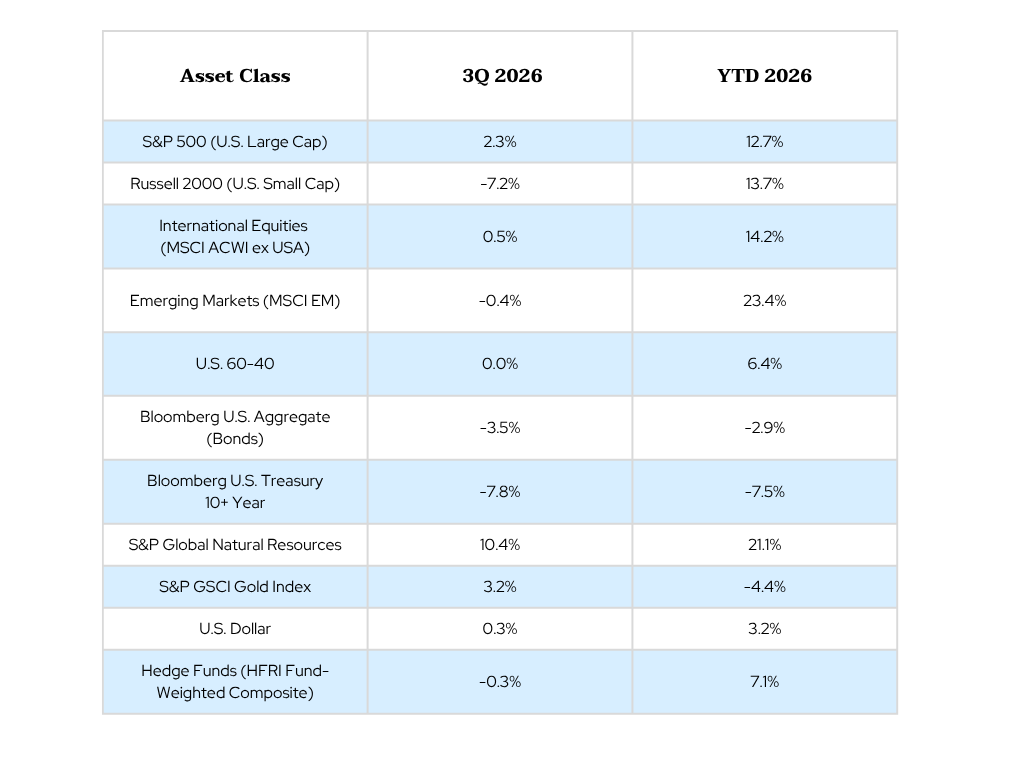
Source: Morningstar Direct. Data as of October 1, 2026. U.S. 60-40 consists of 60% S&P 500 and 40% Bloomberg U.S. Aggregate Bond Index.
Market Perspective
Stocks rose 2.3% while bonds fell 3.5%, and the traditional 60/40 finished the quarter flat. We believe rising yields weighed on both, which is why diversifiers across private markets, alternatives, and other non-traditional strategies matter more than ever.
Stock market gains masked weaker breadth. The S&P 500 is within 2% of its all-time high, yet the median stock is 18% below its 52-week high. Four names (Microsoft, NVIDIA, Apple and Meta) accounted for more than 100% of the index’s gain.4 Small caps, which are more sensitive to higher rates, fell 7.2%.
The 10-year Treasury yield pushed above 5.2%, a 19-year high,1 and yields on some maturities reached their highest levels since 2007.2 Under new Chair Kevin Warsh, the Federal Reserve raised rates for the first time since 2023. Oil also breached $100 a barrel for the first time since May.3
Our latest commentary draws on the nation’s 250th anniversary and its founding motto, e pluribus unum: out of many, one. We explore why rising yields weighed on both stocks and bonds, and how we are building portfolios from a union of parts rather than a pair.
Inside The Commentary
- Learn how the Fed’s first rate hike since 2023, a 10-year Treasury yield above 5.2%, and oil above $100 a barrel shaped the quarter.
- Understand why we believe rising yields weighed on both stocks and bonds, and why a handful of mega-cap names masked weakness in the median stock.
- Explore how active fixed income, alternatives, and real assets may help diversify a portfolio that can no longer count on bonds alone.
A Closer Look
Why did both stocks and bonds struggle to diversify one another? We see three themes at work:
- Rising Yields Weighed on Both Stocks and Bonds. The S&P 500’s forward P/E fell from 20.4 to 19.2 since the end of June, meaning the average stock got cheaper.5 Strong earnings growth kept the index in the black, but we believe stocks would have declined alongside bonds without it. We see three forces behind higher yields: a more hawkish Fed, federal deficits near $2 trillion a year,6 and roughly $194 billion of AI-related investment-grade debt issued in the first half of the year.7
- Market Strength Is Narrower Than It Looks. Large caps held up on the strength of a few mega-cap names, while the Russell 2000 fell 7.2% and financials struggled with higher funding costs. In our view, a market this concentrated leaves portfolios exposed to a small number of outcomes.
- A Coalition Beats a Pair. Shortening bond maturities, holding more cash, and leaning harder into equities is a reasonable response to higher yields, but we believe it exposes a portfolio to different risks, not fewer. We favor a coalition of differentiated strategies, including active fixed income, differentiated credit, multi-strategy hedge funds, and real assets, in an effort to draw on multiple potential sources of return.
Looking Ahead
Heading into Q4, we are watching whether the Fed’s hawkish turn continues, how the Iran conflict and oil prices evolve, and how the path to the midterm elections unfolds. Many of these topics were debated at the AlphaCore Wealth Summit on October 1, and recordings, interviews, and additional content will follow in the weeks ahead.
As always, please reach out to your AlphaCore advisor with any questions about how these themes apply to your specific situation.
Let’s Talk
Reach out to explore how we can help uncover your alpha, or connect with us to discuss these insights further.
[email protected] | 858 875 4100
Commentary Contributors
Eric Gerster, CFA® – Chief Investment Officer
David Stubbs, PhD – Chief Investment Strategist
Johann Lee, CFA® – Director of Research
Madeline Hume, CFA® – Associate Director of Research
Disclosure:
This material is being provided for informational purposes only. This material represents the current views and opinions of AlphaCore Wealth Advisory, and there is no guarantee that any opinions will prove to be accurate, or any forecasts made will come to pass. No obligation is undertaken to update any information, data or material contained herein. AlphaCore provides investment advice only within the context of our written advisory agreement with each AlphaCore client. AlphaCore is not recommending the purchase, sale or holding of any security. Information provided does not constitute an offer or solicitation, and should not be considered tax, legal, or accounting advice.
There is no guarantee that any investment strategy, investment recommendations or decisions will achieve its objectives, generate profits or avoid losses. Past performance is not indicative of future results. All investments are subject to a degree of risk. Risks can include, but are not limited to, increased market volatility, reduced liquidity, or loss of value, including initial invested capital. Alternative investments and strategies are subject to a set of unique risks. Gold and other precious metals may be referred to as a “safe haven” investment or generally presented as a safety asset. These references should not be construed to ensure or guarantee any form of investment safety. Any specific security or strategy is subject to a unique due diligence process, and not all diligence is executed in the same manner. No level of due diligence mitigates all risks, and does not guarantee the elimination of market risk, failure, default, or fraud.
Before embarking on any investment program, you should carefully consider the risks and suitability of a strategy based on your own investment objectives and financial position.
Sources:
1 Source: Morningstar; Koyfin. Data as of September 30, 2026.
2 Source: Sam Goldfarb, “Treasury Yields Reach New Milestone and Threaten Others.” The Wall Street Journal, September 29, 2026.
3 Source: Koyfin. Data as of September 30, 2026.
4 Source: Morningstar. Data as of October 1, 2026.
5 Source: FactSet. “Earnings Insight.” September 25, 2026.
6 Source: Jack Pitcher and Sam Goldfarb, “See the 10-Year Treasury Yield’s Wild Ride on the Road to 5%.” The Wall Street Journal, September 20, 2026.
7 Source: JPMorgan. “Can credit markets absorb the AI buildout?” August 5, 2026.