


Webinar Recap: Is Enterprise Software the Next Phase of AI Value Creation?
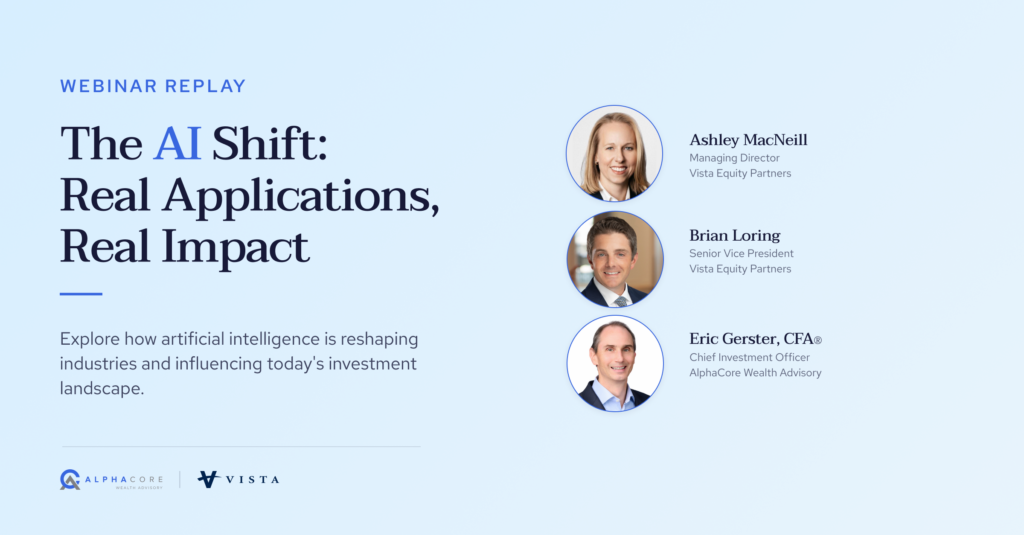
Artificial intelligence (AI) has rapidly evolved since the public release of ChatGPT in late 2022, transitioning from experimental demonstrations to meaningful economic application. In a recent webinar, our Chief Investment Officer Eric Gerster hosted a discussion with Ashley MacNeill and Brian Loring of Vista Equity Partners to examine the implications of AI for public markets, private software companies, and the broader evolution of enterprise software.
For those unable to attend the live session, the full audio replay is available below. You may also follow along by reading the complete transcript.
So what were the biggest takeaways? The conversation centered on a powerful framework for understanding where we are in the AI cycle and why software’s moment may be closer than many investors think.
Phases of the AI Value Cycle
MacNeill described AI adoption as unfolding in three distinct waves. The first wave centers on hardware infrastructure, particularly semiconductors that power AI systems. The second wave involves hyperscalers and AI enablers, where significant early market value has concentrated. The third and emerging wave focuses on enterprise software providers embedding AI into core business workflows. In this phase, systems transition from tracking activities to performing intelligent, decision-support functions.
According to MacNeill, public markets may be underestimating this third phase. Software valuations have faced pressure largely due to uncertainty and limited measurable evidence of durable returns on AI-enabled products. However, she suggested that 2026 may represent a pivotal year in which enterprise adoption becomes more visible in financial results and operational data.
Structural Advantages of Incumbent Software Providers
A significant portion of the discussion addressed concerns that AI-native startups may displace traditional enterprise software providers. MacNeill outlined three structural advantages that incumbents maintain.
First, incumbency creates a competitive moat. Enterprise sales cycles are lengthy, system integrations are complex, and many platforms contain decades of embedded workflows and proprietary data. Replacing these systems is neither simple nor immediate.
Second, trust and determinism remain critical. AI systems are probabilistic by design, meaning outputs are generated based on likelihood rather than fixed rules. Many enterprise functions, including payroll processing and regulatory compliance, require deterministic and rules-based execution. This requirement reinforces the need for established governance frameworks within trusted software platforms.
Third, AI expands total addressable market (TAM) rather than compressing it. As AI agents assume task-level responsibilities, enterprise software increasingly serves as the orchestration and governance layer that manages these agents. In practical terms, if AI functions as the workforce, enterprise software functions as the management infrastructure.
The Emergence of Agentic AI
Loring expanded the discussion by outlining the progression from machine learning (pattern recognition) to generative AI (content creation through prompts) and now to agentic AI. Agentic AI refers to tools capable of executing tasks end-to-end with minimal human instruction.
This evolution represents a meaningful shift. Historically, software improved human productivity. With agentic AI, software may directly perform work on behalf of users. However, Loring emphasized the limitation of hallucinations, defined as AI-generated outputs that appear accurate but are factually incorrect. Because enterprise systems require reliability and compliance, guardrails and governance structures remain essential for safe deployment.
Barriers to Adoption
When evaluating potential obstacles, Loring characterized the risk as one of delay rather than derailment. Two primary friction points were identified: trust and organizational culture.
Enterprises require secure, compliant, and reliable outputs before scaling AI into mission-critical operations. Simultaneously, cultural resistance may present a greater challenge. Organizations must overcome inertia, address concerns regarding job displacement, and redesign workflows to integrate AI capabilities effectively.
Evidence of Value Creation
Despite near-term uncertainty, AI is already generating measurable value within software companies. Vista Equity Partners has observed two primary forms of impact.
First, internal productivity gains are emerging across engineering, customer support, and go-to-market functions. AI-assisted coding tools, automation in customer service environments, and pipeline generation technologies are contributing to operational efficiency. The progression has been deliberate: 2024 emphasized experimentation, 2025 focused on standardization and measurable targets, and 2026 is expected to translate these efficiencies into sustained margin expansion.
Second, companies are developing new revenue streams through agent-enabled products. Loring cited LogicMonitor as an example of a company deploying AI agents to assist IT teams in resolving incidents more efficiently. These capabilities have contributed to both customer cost savings and increased adoption of agent-based offerings.
Shifting Pricing Models
Another significant development involves pricing transformation. Enterprise software has traditionally relied on seat-based pricing models that charge per employee license. Increasingly, vendors may transition toward outcome-based pricing structures in which compensation aligns with measurable value creation.
This transition will require time. Vendors must demonstrate predictable outcomes, and customers must gain confidence in shared-value arrangements. If successfully implemented, outcome-based pricing could create mutually beneficial economic structures. The uncertainty surrounding the pace and execution of this shift contributes to volatility in public software markets.
Practical Implications for Individuals
For individuals navigating the AI transition, Loring offered pragmatic guidance. Continuous experimentation with AI tools enhances familiarity and competence. Additionally, individuals can leverage AI systems directly by asking them how best to apply their capabilities to specific tasks. Because barriers to entry remain low and learning curves are accelerating, those who integrate AI into daily workflows may gain meaningful professional advantages.
Continued Learning
For those seeking further insight into the long-term implications of artificial intelligence for business and investing, Robert Smith’s keynote address from our recent annual Wealth Summit provides additional perspective. In the session below, he discusses the strategic direction of AI, responsible enterprise adoption, and the implications for sustained value creation. His remarks offer a broader contextual framework for understanding the forces shaping the future of markets and technology.
Disclosure: This material is being provided for informational purposes only. This material represents the current views and opinions of the speakers, and there is no guarantee that any opinions will prove to be accurate, or any forecasts made will come to pass. No obligation is undertaken to update any information, data or material contained herein. AlphaCore provides investment advice only within the context of our written advisory agreement with each AlphaCore client. AlphaCore is not recommending the purchase, sale or holding of any security. Information provided does not constitute an offer or solicitation, and should not be considered tax, legal, or accounting advice.
Past performance is not indicative of future results. All investments are subject to a degree of risk. Risks can include, but are not limited to, increased market volatility, reduced liquidity, or loss of value, including initial invested capital. Alternative investments and strategies are subject to a set of unique risks. Any issuers or securities discussed are provided as illustrations or examples only, for the limited purpose of analyzing general market or economic conditions and may not for the basis for an investment decision, nor are they intended to serve as investment advice.
Before embarking on any investment program, you should carefully consider the risks and suitability of a strategy based on your own investment objectives and financial position.
Additional Disclosure: This Presentation is not, and may not be relied on in any manner as, legal, tax, investment, accounting or other advice or as an offer to sell or a solicitation of an offer to buy limited partnership or comparable limited liability equity interests (the “Interests”) in any fund or other similar investment vehicle (each, a “Fund”), including any debt or small-cap buyout fund sponsored by Vista or any of its affiliates. Any such offer or solicitation will only be made pursuant to the final confidential private placement memorandum or other similar offering documents of any such Fund (as amended, supplemented and/or restated from time to time, a “Memorandum”) and such Fund’s subscription documents, which will be furnished to qualified investors on a confidential basis at their request for their consideration in connection with such offering by Vista. The information contained in this Presentation will be superseded by, and is qualified in its entirety by reference to, the applicable Memorandum, which will contain information about the investment objective, terms and conditions of an investment in the applicable Fund, will contain tax information and risk disclosures that are important to any investment decision regarding such Fund and should be read carefully prior to an investment in any Fund. This Presentation does not constitute a part of a Memorandum. No person has been authorized to make any statement concerning any Fund other than as will be set forth in the applicable Memorandum and definitive subscription documents, and any representation or information not contained therein may not be relied upon.
An investment in a Fund entails a high degree of risk. Investors should consider all of the risk factors set forth in Section XI – “Risk Factors” of the Private Placement Memorandum of the applicable Fund, each of which could have an adverse effect on the applicable Fund and on the value of interests in the applicable Fund. There can be no assurances or guarantees that the applicable Fund’s investment objectives will be realized, that the applicable Fund’s investment strategy will prove successful or that investors will not lose all or a portion of their investment in the applicable Fund. Although the use of leverage may enhance returns and increase the number of investments that can be made, it also has the potential to substantially increase the risk of loss of principal. Furthermore, investors should not construe the performance of any predecessor Vista-sponsored funds as providing any assurances or predictive value regarding future performance of the applicable Fund. As with all performance data, past performance can provide no assurance of future results. The scenarios presented are an estimate of future performance based on evidence from the past on how the value of this investment varies, and/or current market conditions and are not an exact indicator. What you will get will vary depending on how the market performs and how long you keep the investment/product. Future performance is subject to taxation which depends on the personal situation of each investor and which may change in the future. Investment may lead to a financial loss if no guarantee of the capital is in place.
Artificial intelligence technology models (“AI”), including generative artificial intelligence and similar technologies (“GenAI”), can pose risks to Vista, the Funds, and their investments. AI is an emerging and rapidly evolving technology and therefore it is difficult to fully assess the risks associated with it and those posed to Vista, the Funds, and/or the Funds’ investments. Vista endeavors to evaluate AI models and related risks before using them in its business. However, there can be no assurance that it will do so successfully, and the use of AI may adversely affect Vista and the Funds and/or the Funds’ investments. Vista is exposed to the risks of these developing and evolving technologies, including in situations where AI is used by third-party service, data, or information vendors, or by companies where the Funds have or are considering an investment. Use of AI implicates risks resulting from inaccuracies in data input and output or signals, modeling, and information security and related regulatory developments, among others. Vista and/or the Funds could incur liability or expenses in connection with claims of infringement or similar claims by third parties related to information which Vista receives through GenAI. As a result, these risks may subject Vista to potential litigation (particularly trademark, licensing terms of use, and copyright claims), conflicts of interest, and/or other legal or operational risks. It is possible that new regulations may emerge in this area which impedes or hinders Vista’s ability to use AI in the future. The adoption of proposed regulatory rules regulating AI and other similar systems may also impose additional obligations and expenses on Vista. Vista’s practices regarding the use of AI potentially disadvantage Vista competitively and there can be no assurance that Vista’s anticipated use of AI will be able to continue without restrictive regulatory requirements. Any of the foregoing factors could have a material and adverse effect on Vista, the Funds and the portfolio companies.
The information contained in this Presentation must be kept strictly confidential and may not be reproduced (in whole or in part) or redistributed in any format without the express written approval of Vista. Neither Vista nor any of its affiliates makes any representation or warranty, express or implied, as to the accuracy or completeness of the information contained herein and nothing contained herein should be relied upon as a promise or representation as to past or future performance of any Fund or any other entity. An investment in any Fund entails a high degree of risk and no assurance can be given that such Fund’s investment objective will be achieved or that investors will receive a return on their capital.
The use of terms such as “Co-Invest” or “Co-Investments”, or references herein to specific co-investment vehicles or to co-investments in general refer to investment vehicles formed pursuant to the “Vista Co-Investment Program”, which includes multiple co-investment vehicles that invest alongside one or more Vista Funds, or to certain other non-promoted co-investment vehicles formed by Vista to syndicate investments made by the Vista Funds. Vista also manages certain single investor vehicles and separately managed accounts (together with any future vehicles and accounts, the “SMAs” and together with any current or future Co-Investments, as applicable, the “Co-Investment Strategies”) that invest alongside the Vista Funds.
As used throughout this Presentation, and unless otherwise indicated, references to the “portfolio” or “Portfolio” of any group of Vista Funds (e.g., the “Vista Equity Funds portfolio”) include all of the investments of the applicable group of related Vista Funds, considered as a whole. In considering any portfolio-wide information contained herein, it is important to note that an individual Vista Fund’s portfolio of investments may, and often does, differ materially in performance and other characteristics from the portfolio of any group of Vista Funds to which such individual Vista Fund belongs.
Operational Intelligence refers to Vista’s longstanding practice of pursuing operational excellence in its investments, including through Vista’s best practices and the use of Vista’s Value Creation Team. This Presentation includes pro forma information related to certain investment transactions that are subject to signed definitive agreements but have not yet closed. Such transactions are subject to regulatory and other customary closing conditions, and consequently there can be no assurance that such transactions will be consummated on the terms currently contemplated or at all. This Presentation includes pro forma non-performance return related metrics through 11/01/2025.
Past performance of transactions, Funds or other entities managed by Vista or any of its affiliates is not necessarily indicative of future results. Investors may lose investment capital. There can be no assurance that any Fund will achieve comparable results or that the returns generated by such Fund will equal or exceed those of other investment activities of the principals of Vista or that such Fund will be able to implement its investment strategy or achieve its investment objectives. No investor in any Fund has achieved the returns of the individual investments set forth herein, and the Fund-level returns of the Funds that made these investments may be lower than the investment-level returns indicated herein.
Statements contained in this Presentation (including those relating to current and future market conditions and trends in respect thereof) that are not historical facts are based on current expectations, estimates, projections, opinions and/or beliefs of Vista. Such statements involve known and unknown risks, uncertainties and other factors, and undue reliance should not be placed thereon. In addition, no representation or warranty is made with respect to the reasonableness of any estimates, forecasts, illustrations, prospects or returns, which should be regarded as illustrative only, or that any profits will be realized. Certain information contained herein constitutes “forward-looking statements,” which can be identified by the use of terms such as “may”, “will”, “should”, “expect”, “project”, “estimate”, “intend”, “continue”, “target” or “believe” (or the negatives thereof) or other variations thereon or comparable terminology. Due to various risks and uncertainties, including but not limited to those set forth in the risk factor section of the applicable Memorandum, actual events or results or actual performance of any Fund may differ materially from those reflected or contemplated in such forward-looking statements. As a result, investors should not rely on such forward-looking statements in making their investment decisions. No representation or warranty is made as to future performance or such forward-looking statements. Statements other than of historical facts, including but not limited to those concerning market conditions, trends, consumer or customer preferences or other concepts, reflect the beliefs of Vista or, when applicable, of one or more Vista Fund portfolio companies or third-party sources.
None of the information contained herein has been filed with the U.S. Securities and Exchange Commission, any securities administrator under any securities laws of any U.S. or non-U.S. jurisdiction or any other U.S. or non-U.S. governmental or self-regulatory authority. No such governmental or self-regulatory authority will pass on the merits of the offering of interests in any Fund or the adequacy of the information contained herein. Any representation to the contrary is unlawful.
Unless otherwise stated, all information presented herein with respect to any Vista Fund is as of 09/30/2025. Any Vista Fund information herein with respect to any period after 09/30/2025 is unaudited and is subject to change. Unrealized Value represents the fair market value of the investment(s). Valuations of unrealized or partially unrealized investments are based on assumptions that Vista believes are reasonable under the circumstances relating to each particular investment. However, there can be no assurance that unrealized investments will be realized at the valuations indicated herein, and used to calculate the returns contained herein, and transaction costs connected with such realizations remain unknown and, therefore, are not factored into such calculations. Estimates of unrealized value are subject to numerous variables that change over time. The actual realized returns on Vista’s unrealized investments will depend on, among other factors, future operating results, the value of the assets and market conditions at the time of disposition, any related transaction costs and the timing and manner of sale, all of which may differ from the assumptions and circumstances on which Vista’s valuations are based. Accordingly, the actual realized return on these unrealized or partially unrealized investments may differ materially. The performance of certain Vista Funds referred to herein that are still in the process of making investments may be significantly affected by future investment activities.
This Presentation describes certain characteristics of companies and/or investments that Vista believes are consistent with its investment philosophy. However, this is not necessarily indicative of the future composition of the portfolio of any Vista Fund (including future funds), and there can be no assurance that any Vista Fund or any Vista portfolio investment will achieve comparable results, that targets or expectations will be met, or that any Vista Fund will be able to implement its investment strategy and investment approach or achieve its investment objectives.
Investment objectives, strategies, policies and senior management may change over time or at any time, with or without prior notice. Past performance is not necessarily indicative of future results and there can be no guarantee that any historical trends will continue over the life of any Vista Fund.
The comparables provided herein were selected by Vista for illustrative purposes because Vista believes that they present direct comparables within the relevant time period. Selection of such criteria is inherently subjective, and others might select other comparables based on their assessment of the market. Actual results may differ, perhaps materially from the estimates presented herein.
Vista’s Value Creation Team (“VCT”) provides services to Vista, the Vista funds, and portfolio companies. VCT personnel are compensated separately for their services by Vista, the portfolio companies, and the funds managed by Vista. Fees or any other type of compensation received in respect of services provided by VCT and/or VCT individuals from portfolio company entities (or otherwise) generally do not reduce or offset the Fund’s Management Fee. From time to time, additional Vista personnel, separate from the VCT, are permitted to be seconded to a portfolio company and Vista is permitted to seek reimbursement from such portfolio company for fees and expenses related to such individuals. Such reimbursement would not reduce or offset the Fund’s Management Fee.
The projections included in this Presentation have been prepared and are set out for illustrative purposes only, and do not constitute forecasts. They have been prepared based on Vista’s current view in relation to future events and various assumptions and estimations, including estimations and assumptions with respect to events that have not occurred, any of which may prove incorrect. Actual results may differ materially from projects and there can be no assurance that any historical trends will continue during the life of any Vista Fund.
Historical portfolio company sales and EBITDA figures presented in these materials may be reflected on a pro forma basis for material add-on acquisitions and divestitures, and other significant transactions, if applicable. Additionally, amounts contained in these materials are generally unaudited and may be flash or preliminary amounts reported by portfolio company management. Portfolio company EBITDA reported to Vista may be adjusted for purposes of determining the estimated fair value of such portfolio company in accordance with Vista’s valuation policy. Sales and EBITDA figures discussed in these materials with respect to companies pre-acquisition are believed to be from reliable sources, but Vista does not attest to their accuracy.
With respect to any information herein relating to potential investment opportunities for one or more Vista Funds, it is important to note that neither Vista nor any of the Vista Funds has consummated such potential investments, and there is no assurance that such potential investments will ever be purchased by a Vista Fund. In addition, actual investments purchased by the Vista Funds may differ materially in terms and performance from any potential investments discussed herein.
Case studies and other descriptions of specific investments presented herein are for informational purposes only and are intended to illustrate Vista’s sourcing experience and the profile and types of investments previously pursued by Vista. It should not be assumed that investments made in the future will be comparable in quality or performance to the investments described herein. Further, references to specific investments included herein should not be construed as a recommendation of any particular investment or security. The investments listed should not be assumed to have been profitable. Past performance is not an indication of future results. The metrics regarding select aspects of the company’s operations were selected by Vista on a subjective basis. Such metrics are provided solely for illustrative purposes to demonstrate elements of the company’s business, are incomplete, and are not necessarily indicative of the company’s performance or overall operations. There can be no assurance that historical trends will continue throughout the life of the Fund.
The private equity benchmark statistics provided herein reflect the investment performance of collections of U.S. private equity funds and U.S. mezzanine funds selected by, among others, Preqin Ltd. and PitchBook Data, Inc. (collectively, the “PE Benchmarks”). The returns of the funds included in the PE Benchmarks are net of all applicable fees, expenses and carried interest. The public equity benchmarks (“Public Benchmarks”) provided herein include the Nasdaq Composite (the “Nasdaq Composite”), NASDAQ-100 Index (the “NASDAQ-100”), the Russell 3000 Index (the “Russell 3000”), the Russell 1000 Index (the “Russell 1000”), the S&P 400 Mid Cap Index (the “S&P 400”), and the S&P 500 Index (the “S&P 500”) which includes dividends calculated monthly. The Nasdaq Composite is a stock market index that includes almost all stocks listed on the Nasdaq Stock Market. Along with the Dow Jones Industrial Average and S&P 500, it is one of the three most-followed stock market indices in the United States. The composition of the NASDAQ Composite is heavily weighted toward companies in the information technology sector. The NASDAQ-100 includes 100 of the largest domestic and international non-financial securities listed on The Nasdaq Stock Market based on market capitalization. The NASDAQ-100 reflects companies across major industry groups including computer hardware and software, telecommunications, retail/wholesale trade and biotechnology. The NASDAQ-100 does not contain securities of financial companies including investment companies. The Russell 3000 encompasses the 3,000 largest U.S.-traded stocks, in which the underlying companies are incorporated in the U.S. The Russell 1000 encompasses the 1,000 largest companies in the U.S. equity market. The Russell 1000 is a subset of the Russell 3000. The S & 400 is a well-known stock market index that measures the performance of mid-sized companies, assuming reinvestment of dividends. The S&P 500 sets forth the performance of a well-known broad-based stock market index, assuming reinvestment of dividends. This index contains only seasoned equity securities. Investors generally cannot invest directly in the PE Benchmarks or the Public Benchmarks (together, the “Benchmarks”), each of which is presented for reference purposes only. The statistical data regarding the Benchmarks has been obtained from sources believed to be reliable. Vista intends to pursue, and the Vista Funds have pursued, a private equity strategy (for the Vista Equity Funds) or a credit strategy (for the Vista Credit Funds), in each case focused on software companies, although Vista may also make, and the Vista Funds have made, investments outside of these respective strategies from time to time. The Vista Funds likely will not pursue other strategies followed by some or all of the funds included in the Benchmarks, nor will Vista, nor the Vista Funds, invest in the funds or other securities comprising the Benchmarks. In addition, the funds comprising the PE Benchmarks invested across a variety of industries whereas Vista intends to focus, and the Vista Funds have focused, on software companies. In addition, an investment in any Vista Fund generally is subject to expenses, management fees and carried interest or incentive allocation charged or payable by the applicable Vista Fund, none of which are reflected in the Public Benchmarks. For the foregoing and other reasons, the returns achieved by the Vista Funds and the returns of the Benchmarks should not be considered comparable.
Third-party logos, including third-party private equity sponsors and other companies, included herein are provided for illustrative purposes only. Inclusion of such logos does not imply affiliation with or endorsement by such firms or businesses. There is no guarantee that Vista or its portfolio companies will work with any of the firms or businesses whose logos are included herein in the future.
There is no guarantee that Vista will successfully implement and make investments in companies that create positive sustainability impact while enhancing long-term shareholder value and achieving financial returns. To the extent that Vista engages with companies on sustainability practices and potential enhancements thereto, such engagements may not achieve the desired financial and social results, or the market or society may not view any such changes as desirable.
- The limited partnership interests (“Interests”) in the Fund are being offered as a private placement to a limited number of sophisticated investors and will not be registered under the U.S. Securities Act of 1933, as amended, and the rules and regulations promulgated thereunder (the “Securities Act”), or the securities laws of any U.S. state or non-U.S. jurisdiction and may not be sold or transferred without compliance with all applicable U.S. federal and state and non-U.S. securities laws.
- The Fund will not be registered as an investment company under the U.S. Investment Company Act of 1940, as amended, and the rules and regulations promulgated thereunder (collectively, the “Investment Company Act”).
- An investment in the Fund entails a high degree of risk. There can be no assurances or guarantees that the Fund’s investment objectives will be realized, that the Fund’s investment strategy will prove successful or that investors will not lose all or a portion of their investment in the Fund. Investors must have the financial ability and willingness to accept the risks and lack of liquidity characteristic of the investment described herein, including the possibility of partial or total loss of capital.
- Investors in the Fund are placing their investment in the Fund in the exclusive discretion of, and are dependent upon the skill and experience of, Vista, its affiliates and their investment personnel. A loss of the services of key personnel, particularly one or more senior or critical investment professionals, could impair Vista’s ability to provide services to the Fund, and therefore the performance of the Fund.
- Vista has multiple advisory, transactional, financial and other interests that in certain situations conflict with those of the Fund and the Limited Partners. Vista is expected to in the future engage in additional activities that result in additional conflicts of interest. Any such conflicts could have a material adverse effect on the Fund and its Limited Partners. There can be no assurance that Vista will resolve all conflicts of interest in a manner that is favorable to the Fund. By acquiring an interest in the Fund, each such Limited Partner will be deemed to have acknowledged and consented specifically to the existence of actual, apparent and potential conflicts of interest relating to Vista, including those described herein and in the Memorandum.
- Although the use of leverage may enhance returns and increase the number of investments that can be made, it also has the potential to substantially increase the risk of loss of principal. The Fund reserves the right to leverage its investments with debt financing at the fund and/or portfolio investment level, including through debt financing. Although the use of leverage may enhance returns and increase the number of investments that can be made by the Fund, it may also substantially increase the risk of loss. The General Partner may be required to call additional capital, use the proceeds distributed from the Fund or otherwise reduce the Fund’s outstanding leverage. Furthermore, the lenders may have rights to enforce remedies against investors in the Fund who default in payment of capital calls. In addition, investors in the Fund may be obligated to subordinate any rights or claims they have against the Fund to the rights and claims of lenders.
- The private equity industry generally and the success of the Fund’s investment activities will be affected by general economic and market conditions. Instability in the securities markets and economic conditions generally (including a slow-down in economic growth and/or changes in interest rates or foreign exchange rates) may also increase the risks inherent in the Fund’s investments and could have a negative impact on the performance and/or valuation of the Fund’s portfolio companies.
- The Fund’s investments will be concentrated in the software sector. Concentration in a single industry may involve risks greater than those generally associated with diversified investment funds, including significant fluctuations in returns. The software industry is challenged by various factors, including rapidly changing market conditions and/or participants, new competing products, changing consumer preferences, short product life cycles, services and/or improvements in existing products. Instability, fluctuation or an overall decline within the software industry will likely not be balanced by investments in other industries not so affected. In the event that the software sector as a whole declines, returns to Limited Partners may decrease.
THE FOREGOING LIST OF RISK FACTORS DOES NOT PURPORT TO BE A COMPLETE ENUMERATION OR EXPLANATION OF THE RISKS INVOLVED IN AN INVESTMENT IN THE FUND. PROSPECTIVE INVESTORS SHOULD READ THE ENTIRE MEMORANDUM, INCLUDING THE “RISK FACTORS AND POTENTIAL CONFLICTS OF INTEREST” SECTION SET FORTH THEREIN, AND CONSULT WITH THEIR OWN LEGAL, TAX AND FINANCIAL ADVISORS BEFORE DECIDING TO INVEST.
Transcript
Speakers
- Eric Gerster, CFA®: Chief Investment Officer at AlphaCore
- Ashley MacNeill: Co-Head of Capital Markets at Vista Equity Partners
- Brian Loring: Senior Vice President at Vista Equity Partners
Chapter 1 (00:01): Welcome
Eric Gerster, CFA®, Chief Investment Officer at AlphaCore (00:01)
Well, welcome everyone to our monthly AlphaCore webinar series. I’m Eric Gerster, Chief Investment Officer at AlphaCore. We’re excited about today’s discussion and appreciate you taking time out of your schedule to join us.
For those who may not know us, AlphaCore is a registered investment advisor headquartered in La Jolla, California, with offices across the country. We’re a full-service wealth management firm that combines comprehensive wealth planning with a dedicated investment research team, allowing us to build customized investment strategies designed to help our clients reach their financial goals.
With that, let’s jump in. Artificial intelligence has taken the world by storm since ChatGPT launched in late 2022. We’re seeing its impact everywhere—from the stock market to how we make restaurant reservations, plan trips, and even how businesses operate.
Today, we’ll discuss what AI means for public markets and then shift to real-world use cases, including how AI is creating meaningful value across enterprise software companies.
I’m pleased to be joined by Ashley MacNeill and Brian Loring from Vista Equity Partners.
Ashley, I’ll turn it over to you.
Chapter 2 (02:25): Vista Overview + Market Context
Ashley MacNeill: Co-Head of Capital Markets at Vista Equity Partners (02:25)
Thank you so much for having us. Vista Equity Partners is a private equity firm with just over $100 billion in assets under management. We invest across a broad range of market capitalizations—from under $100 million to several billion—and we focus primarily on what historically has been enterprise software, which is increasingly evolving into agentic enterprise software.
Your timing for this discussion is impeccable given the dislocation we’re seeing in public markets around this asset class. We’re excited to dive in.
Chapter 3 (03:10): Public Market Dislocation + AI Value Cycle
Eric (03:10)
Over the last 12 months—especially this year—we’ve seen publicly traded enterprise software companies experience significant selloffs. Vista has invested in software for 25 years through multiple cycles.
Walk us through Vista’s view on what’s happening in public markets and how that connects to AI overall.
Ashley (04:16)
What you’re seeing in the public markets is recognition that, in this AI wave, software is not yet viewed as the fastest-growing, most durable, highest-margin asset class. There’s a lack of data points to get investors excited.
We believe AI adoption will follow three phases—similar to past technology transitions:
- Hardware and semiconductors
- Hyperscalers and AI enablers
- Enterprise software embedding AI into core workflows
That third wave is emerging now. It’s exciting—but until we see data points proving AI-embedded software is delivering results, uncertainty will remain.
Chapter 4 (06:39): Why 2026 Is Pivotal
Eric (06:39)
Where are we in the value creation cycle? How far are we from seeing evidence that software companies are driving real AI value?
Ashley (06:39)
It feels like we’re at the precipice. I believe 2026 will be a critical year for enterprise AI adoption.
For AI investment to justify itself, everyday companies must adopt it. And to adopt AI meaningfully, they need software to facilitate and operationalize it.
It won’t happen overnight. But as we begin hearing from major consumer companies about efficiencies driven by AI, value will start shifting from semis and hyperscalers toward software and agentic enterprise platforms.
Change takes time. Cost curves must make sense. Adoption requires willingness. But we believe the inflection point is approaching.
Chapter 5 (10:22):Why AI Won’t Eliminate Enterprise Software
Eric (10:22)
You mentioned several reasons AI won’t eliminate enterprise software. Can you revisit those?
Ashley (10:22)
Three primary reasons:
1. Incumbency and switching costs
Enterprise sales cycles can take years. Many platforms have 20+ years of proprietary workflows and embedded data. Enterprises won’t rip that out for a three-year-old AI-native company.
2. Trust and determinism
AI is probabilistic. Enterprise workflows often require deterministic execution. Payroll must execute correctly every time. Software will leverage AI thinking—but execute with certainty.
3. Expanding TAM
AI expands software’s total addressable market. If agents perform work, software must orchestrate and manage them. That creates massive opportunity.
Chapter 6 (14:05):Private vs Public Software
Eric (14:05)
What’s unique about private software companies adopting AI versus public ones?
Ashley (15:08)
The public market represents less than 5% of available data points on software health. In private markets, companies often have more flexibility to experiment and embed AI without quarterly earnings pressure.
Chapter 7 (16:59): IPOs, M&A, and New KPIs
Eric (16:59)
How does AI impact exits and dealmaking?
Ashley (16:59)
AI will reshape public equity and M&A markets. We’ve seen cycles like this before.
I also expect new KPIs centered around AI—metrics like revenue per head, number of agent tasks completed, ROI per agent. Investors need clearer ways to evaluate AI usefulness.
Chapter 8 (19:30): Agentic AI Explained
Eric (19:30)
Brian, what does agentic AI mean?
Brian Loring, Senior Vice President at Vista Equity Partners (19:30)
AI evolved from machine learning to generative AI—and now to agentic AI.
Agentic AI can perform tasks on your behalf without step-by-step prompts. For example, you could tell an agent to handle your monthly bills, and it would determine what needs to be paid and execute it.
This moves software from productivity assistance to actual work execution.
Chapter 9 (22:31): Hallucinations + Governance
Eric (22:31)
What about hallucinations?
Brian (23:11)
Hallucinations occur because models are probabilistic—they predict likely answers based on patterns. Sometimes they’re wrong.
In regulated industries, workflows must be deterministic. If the same loan profile is input, the same answer must result every time. That’s why governance layers and guardrails are critical.
Chapter 10 (26:33): What Could Delay Adoption?
Eric (26:33)
What could delay adoption?
Brian (26:33)
Two main factors:
- Trust — compliance, governance, reliability
- Culture — employees must adopt tools without fear
The bottleneck is often change management, not technology.
Chapter 11 (28:51): Advice for Everyday Users
Eric (28:51)
What advice would you give individuals trying to use AI better?
Brian (29:22)
Experiment. Try things. Fail fast.
Also—ask the AI how to use it. Describe your workflow and ask how it can help. It becomes collaborative.
Chapter 12 (32:41): Productivity + Revenue in Portfolio Companies
Eric (32:41)
What are you seeing across Vista’s portfolio?
Brian (33:10)
We think about AI impact in two buckets:
- Internal productivity gains
- Revenue growth through agentic offerings
2024 was experimentation.
2025 was tool selection and target setting.
2026 is “show me the money.”
Chapter 13 (37:19): LogicMonitor Case Study
Brian (37:19)
LogicMonitor helps IT departments resolve incidents. With agents, it now reduces resolution time and increases efficiency.
Its agent product grew 3x last year. It’s an early example of agentic monetization.
Chapter 14 (41:55): Seat-Based vs Outcome-Based Pricing
Eric (41:55)
How does pricing change?
Brian (41:55)
We’re moving from seat-based pricing toward outcome-based pricing—sharing in the value delivered.
It will take time. The on-prem-to-cloud transition took a decade. This shift will be multi-year as well.
Chapter 15 (49:51): New Winners + Long-Term Outlook
Eric (49:51)
Will we see new winners like we did in cloud?
Brian (50:32)
Today’s AI-native companies are creating new categories—not disrupting existing ones yet.
Over time, winners will emerge. But agents require context, governance, and workflow integration—advantages incumbents already possess.
Chapter 16 (54:16): Closing
Eric (54:16)
Brian, thank you—and thank you to Ashley and Vista Equity Partners for joining us.
Brian (54:16)
My pleasure. Thanks so much, Eric.
Eric (54:16)
Take care.